Between Agility and Control: Why Cloud Strategies Need to Be Rethought
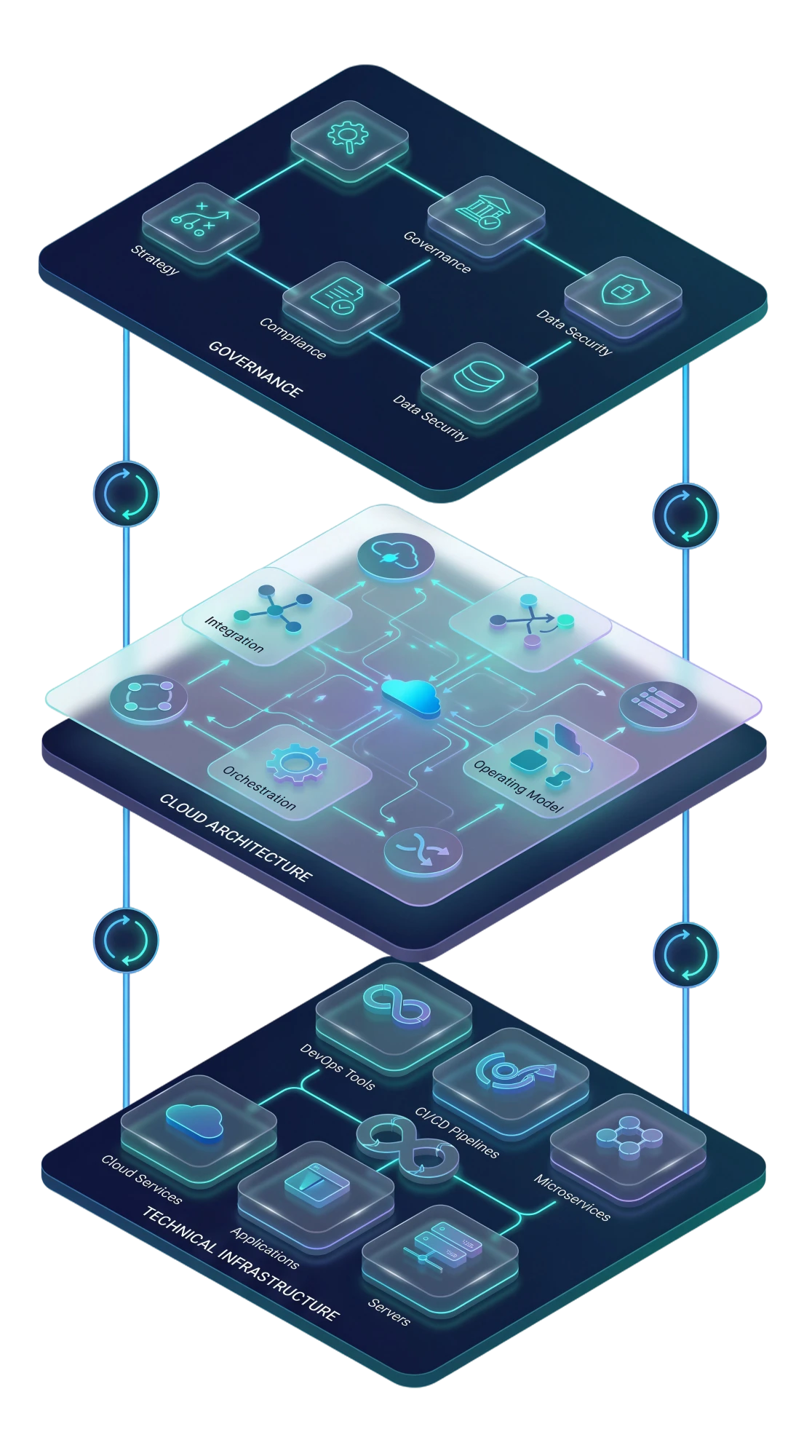
Today, cloud initiatives rarely start in the data center. They often emerge within business units—driven by the pressure to innovate, new business requirements, and the desire for greater speed. At the same time, demands for security, compliance, and governance are constantly rising. Companies are thus navigating a tension that increasingly shapes the cloud debate: How can agility and control be reconciled?
The podcast episode “Top-Down Meets Bottom-Up: Multi-Cloud Architecture in Practice”. It demonstrates why successful cloud strategies must bring together different perspectives—from technical infrastructure to strategic enterprise architecture. The real added value arises where both levels interlock.
Cloud Architecture Doesn’t Start with Technology
Cloud transformations rarely follow a uniform pattern. While some organizations develop their architecture based on technology, others focus first on business processes, value chains, and strategic goals.
Both approaches can be successful. However, what matters is not the starting point, but the ability to consistently integrate technical and business perspectives. Only then can an architecture emerge that both enables innovation and remains manageable in the long term.
Data sovereignty becomes a management task
The discussion surrounding cloud strategies has changed significantly in recent years. Whereas infrastructure used to be the primary focus, today the spotlight is on issues such as data sovereignty, regulatory requirements, digital sovereignty, and trust.
At the same time, the major hyperscalers continue to dominate the market, while specialized providers are creating new options. For CIOs and CEOs, this means that standard solutions are increasingly no longer sufficient. Cloud strategies must take into account the organization’s individual priorities—from compliance requirements to innovation goals.
Why Simple Migrations Often Fall Short of Expectations
Many cloud projects initially take a pragmatic approach: applications are moved to new environments as quickly and with as little risk as possible. However, the expected benefits often fall short of expectations.
The reason rarely lies in the technology itself. Without adapting architecture, operating models, and processes, the result is merely a new location for existing structures. The true potential of the cloud is only realized when companies transform their working methods and organizational models as well.
Cultural Change Becomes a Key Success Factor
Cloud computing is transforming far more than just the technological landscape. Automation, DevOps principles, and clearly defined responsibilities are increasingly becoming key success factors.
For executives, this means questioning established organizational structures and promoting new forms of collaboration. Those who simply transfer existing processes to the cloud without modification are only partially tapping into its potential. Cultural change may be less visible than technological modernization—but it is often more critical to long-term success.
Artificial Intelligence as an Accelerator—Not a Replacement
The use of AI is also changing the way work is done in IT and business. Analyses can be performed faster, information structured more efficiently, and the basis for decision-making better prepared.
Nevertheless, key management tasks remain fundamentally human. Strategic decisions, risk assessments, and communication between departments, IT, and management cannot be fully automated. It is precisely in this combination of technological support and human expertise that sustainable value is created.
The Cloud Is a Leadership Decision
Today, the cloud is much more than just an infrastructure issue. It impacts business models, governance, and organizational structures, forcing companies to think about and design technologies, processes, and responsibilities holistically. This is precisely where the challenge—and the opportunity—lies: Organizations that approach this transformation holistically lay the groundwork for greater innovation, resilience, and competitiveness.
Listen now
Find out which specific approaches have proven effective in practice and what role multi-cloud architectures play in this context in the podcast “IT.People.Skills”.
Team SPIRIT/21
E-Mail: info@spirit21.com
The SPIRIT/21 team will be happy to advise you on all aspects of your IT tasks, from consulting and implementation to the operation of individual services and complete IT infrastructures. We deliver solutions that work. We look forward to hearing from you.